
The Metaverse: Reimagining Our Digital Identity
Stay updated with us
Sign up for our newsletter
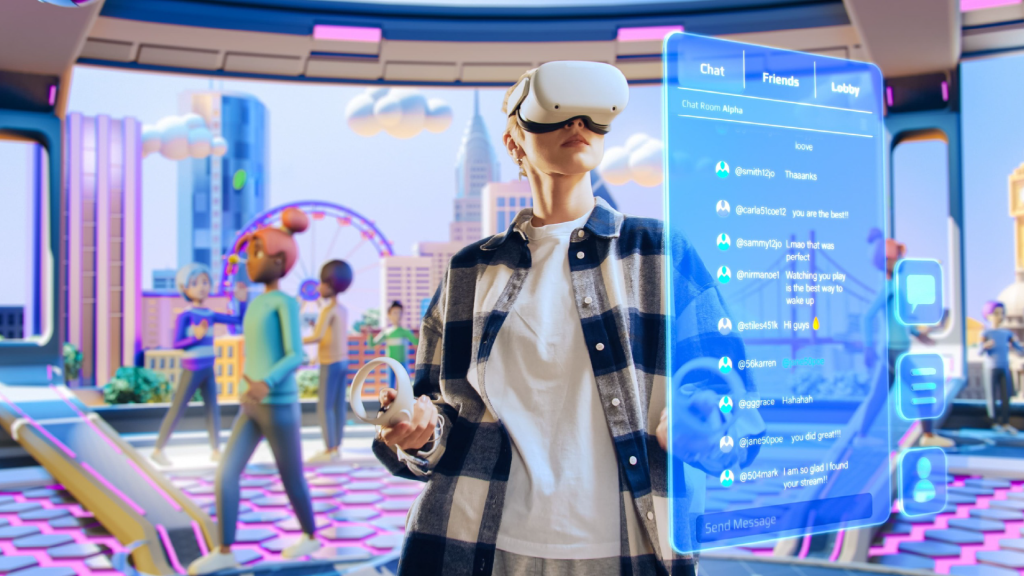
The word “metaverse” is now widely used and has transitioned from science fiction to a strategic priority. Once, the metaverse was viewed as new digital spaces for gamer-futurologists; now it is being proactively investigated, planned and, in some cases, constructed by tech giants, businesses, and even governments. However, beyond its telling and immersive visuals and 3d spaces, is something more impactful; it will possibly change how we understand identity.
Digital Identity & its Evolution
At this point, our identities online are disparate; we are one person on LinkedIn, another person on Instagram, and an entirely different person on gaming platforms. Each online space gives us a small representation of who we are, but none to tell the entire story. This begins to change in the metaverse. Imagine a place where your one identity travels with you from space to space. You could walk into a virtual coworking space, take part in a concert in Decentraland, and visit a museum in Spatial, and every time it would be the same “you”, the same avatar, same style, same possessions, and even the same social status.
Our avatars, digital versions of ourselves, have started to evolve. They used to be cartoon-style characters; now they can be similar to us—or look entirely different if we so choose. Some people build avatars that are just like them; others build versions based on their imaginations. The same avatar can also be used in multiple spaces. For example, some platforms such as Ready Player Me allow a user to import a single avatar into various games and apps. The avatar can be a digital twin of real life or a figment of fantasy.
NFTs and Verified Credentials
Another key concept in the metaverse is ownership, making sure that what you have digitally online is actually yours. NFTs or non-fungible tokens make this possible. NFTs are unique digital items that verify you own something. For example, Gucci has made virtual bags for Roblox, and people actually bought them to carry around in virtual worlds. Vans has created a skate park in the metaverse that attracted millions of players to pick up virtual skateboards and other gear. These digital items become part of who we are and how we express ourselves to others.
In the metaverse, our identity is not just limited to how we look or what we own, it is also a part of what we know and what you have done. In the real world, we provide resumes and certificates. In the Metaverse, these could come in the form of secure digital documents on a blockchain. Students might receive verifiable virtual diplomas that cannot be forged and individuals might display past work experiences on their Metaverse profiles. At work, we could use our virtual profiles to access our whole job history, skills, and projects without needing to search for our resume or portfolio. All we have to do is login.
Additionally, with a consistent digital identity, the continual struggle with problems like catfishing and bullying may be reduced in the social area. If everyone used a verified avatar, it would be easier to trust who we meet online, making virtual spaces more secure and friendly.
Many real world companies are already building for this future. Nike operates NIKELAND on Roblox where users can play and adorn their avatars in Nike gear. Balenciaga launched digital garments in Fortnite which gives players additional options to customize their avatars. Samsung recreated their iconic NYC store in Decentraland and welcomed visitors to a mixed-reality encounter. Disney developed AR concepts that allowed guests in a physical theme park the ability to collect digital amenities that were tied to their avatars.
The Challenges of Trust and Safety
While this vision is full of opportunity, there are real challenges that we need to consider. Cybercriminals may capture an individual’s voice or likeness increase deepfake impersonation and resulting identity theft. As an additional consideration, platforms may collect ever-more data about our movements, gestures, and even measurements of our biometrics, perhaps without us fully realizing it. Finally, inherently, we are already used to unequal access to the new online tools, some avatars and digital items may simply be more than we can afford, which may lead to serious inequity in our assigned experience of new virtual spaces.
An even greater consideration is that there are a number of different companies building separate virtual worlds. There are no common rules, so the identity you see in the current platform may still be trapped in that one environment. It may be difficult to transport your history, materials, or reputation from one space to another.
Fortunately, people are trying to solve these issues. The European Union is developing digital wallet photography systems and organizations like the W3C and Decentralized Identity Foundation will develop open standards that allow all platforms to communicate with each other. Ultimately this will allow our digital identity to be transportable, secure, and owned and controlled by us.
In summary, the metaverse is not just a space to play video games or other digital applications. The metaverse is a new space for living, le narning, working, and socializing. Our digital identity is the center of everything we do in our life. If we construct virtual spaces with careful thought for accessibility, security, and ethical use of our digital data, these spaces can continue to be a space of new creativity, connection, and chance for fairness. But if we turn a blind eye on the risks, we could end up in a dystopia filled with surveillance, fraud, and unequal access.
Regulation & Ethics: Who is Governing our Identity in the Metaverse?
Governments and organizations are beginning to take their place, for instance, the EU (European Union) has announced digital identity wallets for citizens. And, technology consortiums like the Decentralized Identity Foundation, and W3C are striving to build interoperable standards in digital identity infrastructure. There is still a long road ahead with this.
Final Thoughts
Although the metaverse might be considered a sort of virtual playground, it is more accurately a reinvented human experience: how we live, work, and play. All of this variation is now oriented around our digital identity: no longer a static profile, but an active-lived expression of our self-hood in a limitless digital landscape.
There is a lot that remains uncertain and unknown about how we go forward, but the risk of getting identity right / wrong is great. If we can get identity right, we have the potential to unleash oceans of creativity, inclusion, and liberty – if we get it wrong, we may put ourselves on the path to a future dominated by surveillance, inequality, and separation.
This is not just about technology, it’s about discovering who we are in a new, shared online world. The metaverse is shaping our digital identity – but it’s also shaping us.
Latest Stories
Dark Web 2.0: The Rise of Cybercrime Ecosystems
When AI Dreams: Could Neural Networks Ever Experience a Subconscious?