FedNow vs RTP Network: Key Differences, Costs and Use Cases
Stay updated with us
Sign up for our newsletter
I only started paying attention to any of this because my dad kept complaining that a bank transfer he sent on a Friday afternoon did not show up until Monday and I thought, wait, its 2024, how is that still a thing. And that one question kind of sent me down this whole rabbit hole about how money actually moves between banks in America and that’s when I first came across FedNow and the RTP network. US now has two separate systems that let banks send money to each other instantly, and I mean actually instantly, not like the same day or within a few hours but genuinely within seconds even if it’s 2 in the morning on a Sunday. Both of them exist at the same time, both are growing fast and the whole FedNow vs RTP network debate that keeps coming up in finance circles is basically just about which one is better and why they are different from each other.
Most people have no idea either of these systems exist which I think is kind of wild because if you have ever used Zelle and been surprised by how fast it sends money, the answer is the RTP network, that is literally what is powering it behind the scenes. So in a way a lot of Americans are already using one of these systems every day without knowing it.
The FedNow vs RTP Comparison: How We Got Two Systems Instead of One
So the reason there are two of these things instead of just one comes down to who built them and when and honestly a bit of politics too.
RTP came first, it launched in 2017 and was built by The Clearing House, which is basically a private company owned by the big banks, JPMorgan, Bank of America, Wells Fargo and that group. They built it because America was way behind other countries on fast payments, the UK, India, Australia all had something like this already and the US was still doing overnight batch transfers like it was 1995. So the big banks finally got together and fixed it themselves.
The problem was they kind of fixed it for themselves. The large banks got on RTP fast but smaller banks, community banks, credit unions, the ones a lot of regular people actually use, most of them never made it onto the network. Too complicated, too expensive, they just got left out.
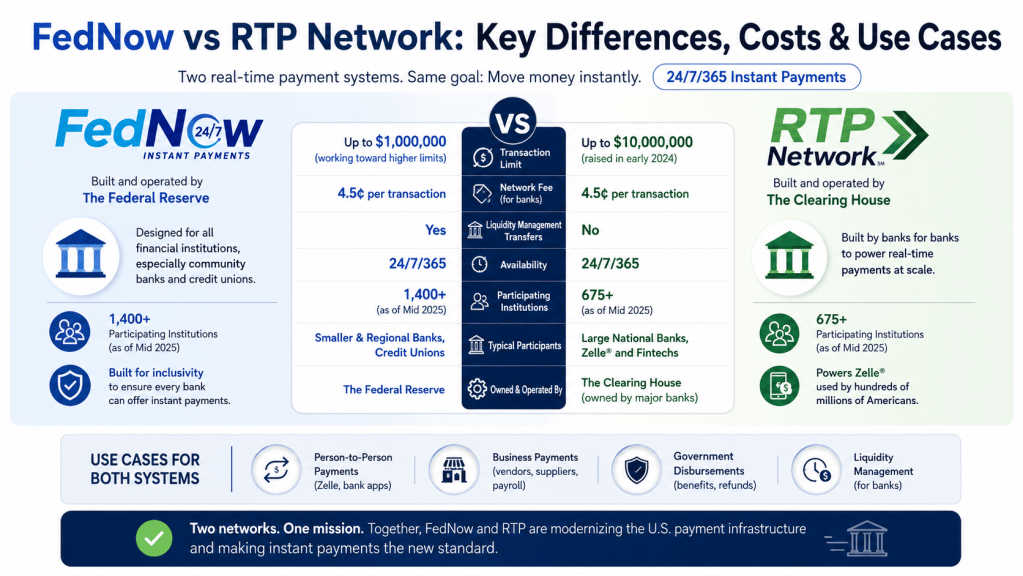
That is exactly why the Federal Reserve stepped in and built FedNow, which launched in July 2023. Same concept but run by the government and built so any federally insured bank could join. By mid 2025 it had over 1,400 institutions on board versus RTP’s 675. More banks on FedNow but RTP’s banks are the big ones handling most of the actual volume.
RTP Network vs FedNow System: The Differences That Actually Matter
Both systems do the same basic job, instant transfers between banks, 24 hours a day, settling in seconds. So what is actually different.
The biggest one is the transaction limit. RTP raised its cap to 10 million dollars per transaction in early 2024, which makes it useful for large corporate payments and things like commercial real estate. FedNow started at 500,000 dollars and was working toward 1 million in 2025, which is better but still nowhere close to what RTP allows. So for really large transfers RTP is the only real option.
FedNow has something called liquidity management transfers which RTP does not. It basically lets banks move their own money between accounts even on weekends and overnight when normal wire systems are closed. Most big banks do not need this because they have treasury teams handling that stuff around the clock, but for smaller institutions it is actually really handy and is one of the main reasons they tend to prefer FedNow.
There are also some technical differences around how banks connect to each network but honestly most people will never need to think about that side of it.
Both networks charge participating banks roughly 4.5 cents per transaction sent, flat rate, no volume discount for bigger banks and no premium pricing for smaller ones, same cost for everyone regardless of size. So the practical answer to how much instant payments cost you is, check with your bank, because it has nothing to do with whether they are on FedNow or RTP, the network fees are basically the same either way, it is entirely about what pricing your specific bank has decided on.
Read More – Real Time Payments in the US: FedNow vs RTP Explained
Real Time Payments FedNow Banks and the RTP Network Participating Banks
This is probably the most useful thing to understand if you are trying to figure out whether any of this affects you personally.
For real time payments through FedNow banks, the list is heavy on smaller institutions. Lots of community banks, credit unions, regional banks that serve specific geographic areas rather than operating nationally. Over 1,400 of them as of mid 2025. The Federal Reserve made a real push to get these smaller institutions on board early and the adoption numbers suggest that strategy worked reasonably well.
For RTP network participating banks the raw number is smaller, around 675, but the institutions are much larger on average. All the major national banks are on RTP and importantly Zelle which is already installed on hundreds of millions of American smartphones settles its payments through the RTP network. So even people whose banks are not formally listed as RTP members are often already using RTP every time they send money through Zelle without having any idea that is what is happening.
The thing that I genuinely did not expect when I started looking into all of this is that about 58 percent of US banks that offer instant payments at all are now connected to both networks, not just one. So the competitive framing of FedNow versus RTP has kind of already been overtaken by reality, most institutions have just decided to join both and maximise their reach rather than picking a side.
US Instant Payment Systems: What This All Means for You
So after going through all of that, here is what it actually means depending on who you are.
If you are an individual with a bank account then honestly you do not have much control over any of this. You do not pick which network your payment travels through, your bank makes that decision automatically based on which networks your bank and the recipients bank are both connected to. The only things worth actually checking are whether your bank supports instant payments at all and whether they are going to charge you a fee to use them. Some do, some do not, and it is worth knowing before you need it.
If you run a small business then the picture is mostly the same but there is one extra thing worth asking your bank about specifically. Ask whether you can send instant payments outbound, not just receive them. A lot of banks joined these US instant payment systems initially by only signing up for the receive side because it is lower risk and easier to implement from a technical standpoint. If you want to pay people quickly, vendors, contractors, whoever, you need the outbound side to be set up too and not all banks have done that yet.
If you are working in fintech or building payment infrastructure then you are probably already across most of this but the short answer is that connecting to both rails makes more sense than picking one because coverage is what matters most and no single network reaches everyone yet.
The bigger picture honestly is that FedNow and RTP are not the zero sum competition that a lot of early coverage made them out to be. They are two parallel systems that together are doing something pretty significant which is dragging American payments infrastructure into the modern era. Instant payments were less than 1 percent of total US payment volume in 2022 and by 2026 that number is expected to be around eight times higher. Both of these networks are going to be part of that growth and both of them are going to matter for a long time.
Read More – What Real-Time Treasury Management Means for Global Businesses
FAQ
What is the main difference in the FedNow vs RTP comparison?
The core difference in the FedNow vs RTP comparison comes down to who built them and which banks use them. FedNow is run by the Federal Reserve and was built to bring instant payments to smaller banks and credit unions that were being left out of the existing private system. The RTP network is run by The Clearing House which is owned by large private banks and has been running since 2017. Both do the same job of sending money between banks in seconds around the clock. The practical differences are transaction limits, RTP goes up to 10 million dollars while FedNow is at around 1 million, and the types of institutions that have joined each one.
How do FedNow fees vs RTP fees work for regular customers?
Both networks charge banks about 4.5 cents per transaction and that rate is the same for both, it does not vary by bank size or transaction volume. What you personally pay as a customer depends entirely on what your bank decides to charge for instant payment services. Some banks offer it free, some charge a small fee per transfer, and some even charge to receive instant payments. The network fee itself is not where any difference shows up for everyday users.
Which RTP network participating banks and FedNow banks have the widest coverage?
FedNow has broader coverage among smaller institutions with over 1,400 participating banks and credit unions. RTP has fewer institutions at around 675 but they include most of the large national banks and the network also powers Zelle which gives it enormous reach among regular consumers. About 58 percent of US banks offering instant payments are now connected to both networks so the overall coverage picture is getting better all the time.
Will FedNow and RTP eventually replace wire transfers and ACH?
For domestic payments where speed matters, instant payments are already starting to take volume away from wire transfers because they are cheaper and just as fast. ACH transfers are a different situation because they are extremely low cost and are used for things like payroll and recurring billing where same-day speed is not always necessary. And since neither FedNow nor RTP handles cross-border payments, wire transfers still play an important role for international transactions. These instant payment systems are really expanding into a specific part of the market rather than replacing everything that currently exists alongside them.
Write to us [wasim.a@demandmediaagency.com] to learn more about our exclusive editorial packages and programmes.