Top Embedded Finance Companies in the US You Should Know
Stay updated with us
Sign up for our newsletter
Imagine you own a restaurant in Austin. Your point-of-sale system does more than just track orders and process payments. At the end of the month it offers you a business loan based on your sales. No need to visit a bank, no paperwork and no waiting for weeks for approval. The money shows up in your account in two days and repayments are automatically deducted from your sales. This restaurant owner is using embedded finance. Probably doesn’t even know it has a name. That’s the point. The embedded finance companies in the US build financial services that feel natural inside the products people already use. You don’t think, “Wait, is my restaurant software a bank now?”
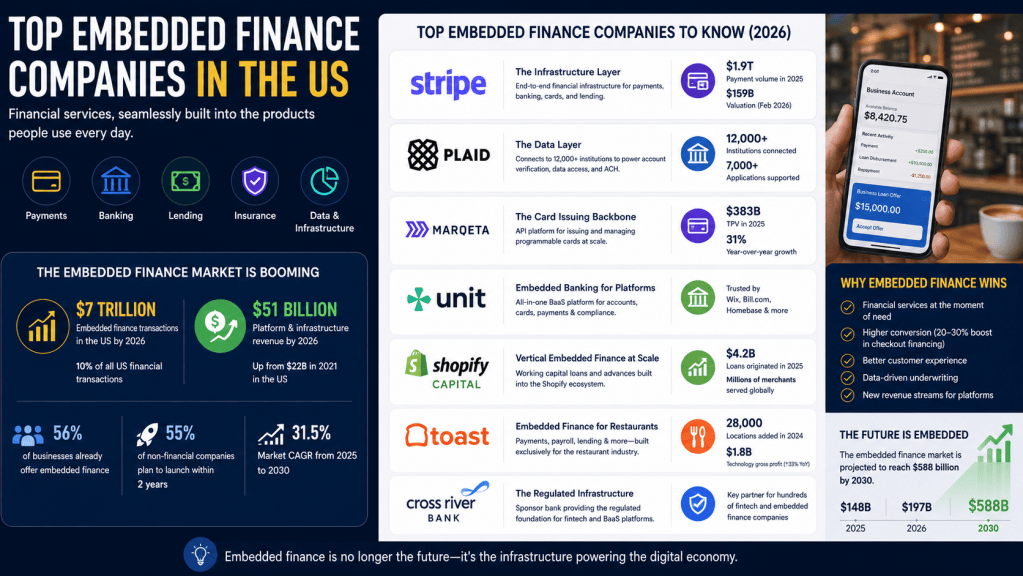
The market backing this shift is huge. Embedded finance transactions in the US are expected to reach $7 trillion in 2026 making up 10% of all US financial transactions. The platform and infrastructure revenue from embedded finance companies is expected to more than double from $22 billion in 2021 to $51 billion by 2026 in the US alone.
What Embedded Finance Companies Do?
Before we dive into the list lets be clear about what makes an embedded finance company different from a fintech or bank. An embedded finance company provides the infrastructure, APIs or platforms that let non-financial businesses offer products inside their existing products. The business doesn’t become a bank; it just uses a layer of infrastructure to offer things like payments, lending or insurance to its customers. 56% of businesses already offer some form of embedded finance, and 55% of non-financial companies plan to launch these services within two years. That adoption rate is what makes this category so important to understand right now. The companies on this list are the ones building the rails that all of that runs on.
Stripe: The Infrastructure Layer
If you’ve bought anything online in the past five years you’ve probably used Stripe without realizing it. Stripe started as a payments company. Has become one of the most comprehensive embedded finance platforms in the world. Stripe processed $1.9 trillion in payment volume in 2025 a 34% increase year over year. Stripe’s February 2026 valuation reached $159 billion. The platform now powers more than 5 million businesses, including 90% of the Dow Jones Industrial Average and 80% of the Nasdaq 100.
For businesses looking at embedded finance in the US, Stripe is relevant across multiple layers. Stripe Connect handles marketplace and platform payments. Stripe Treasury is the banking as a service product that lets platforms offer financial accounts and cards to their users. Stripe Capital offers revenue based lending. Together, these make Stripe one of the few companies that can serve a business across the full embedded finance stack from a single integration.
Plaid: The Data Layer
Most people have never heard of Plaid but they’ve probably used it. When an app asks you to connect your bank account, Plaid is usually the technology making that connection work. Plaid connects to over 12,000 institutions and supports more than 7,000 applications globally. That network makes it the dominant data infrastructure layer for embedded finance companies that need to verify bank accounts, check balances, confirm identities, or enable ACH transfers. Its real-time data connections make account verification pay-by-bank options and income verification possible.
Marqeta: The Card Issuing Backbone
Like Plaid owns the data layer and Stripe owns the payments layer, Marqeta owns the card issuing layer. It’s the company behind the technology that lets businesses create branded debit and credit cards with spending rules. Marqeta TPV increased from $291 billion to $383 billion in 2025 with an annual increase of 31%. Its clients include DoorDash, Instacart, Klarna and Square. What makes Marqeta stand out among embedded finance companies in the US is the programmability of its cards. You can set rules like “this card can only be used at specific merchant categories” or “spending above $500 requires manager approval.” That kind of control is what makes it the go-to for expense management products, gig economy payouts, and buy-now-pay-later programs.
Unit: Embedded Banking for Startups and Platforms
Unit is one of the more developer-friendly names in the embedded finance space. It is an all-in-one banking-as-a-service platform that handles accounts, cards, payments and compliance through an API. It’s designed for US software companies that want to add features without building their own banking infrastructure.Companies like Wix, Bill.com and Homebase use Unit to offer banking features to their business customers. Unit is one of the capitalized infrastructure leaders to emerge from the investment wave in embedded finance and BaaS startups.
Shopify Capital: Vertical Embedded Finance at Scale
Shopify Capital is an example of what embedded finance looks like when built directly into a vertical platform. Shopify merchants can access working capital loans and cash advances inside the Shopify dashboard. Shopify Capital originated $4.2 billion in merchant cash advances and loans in 2025. This model is powerful when you have both distribution and data. This is the version of embedded finance in the US that most small business owners actually experience. Not APIs and developer documentation, but a loan offer appearing inside the tool they use every day, underwritten by their own business data.
Toast: Embedded Finance Specifically for Restaurants
Toast is what happens when a software company goes deep on one vertical and builds the financial services layer specifically for it. Toast started as a point-of-sale system for restaurants. Has expanded into payroll, business loans and payment processing. It’s a platform designed exclusively for the food service industry. Toast added a record 28,000 locations in 2024 and reported its first year of GAAP profitability with $373 million in adjusted EBITDA. Its technology gross profit grew 33% year over year to $1.8 billion. As a case study in vertical embedded finance, Toast is one of the clearest examples of how going narrow and deep can produce enormous financial services revenue that a generalist bank could never have captured.
Cross River Bank: The Regulated Infrastructure
Most people have never heard of Cross River but it has been the sponsor bank behind an enormous number of the embedded finance companies in the US that are household names. Cross River is a New Jersey-based bank that provides banking infrastructure for fintechs and embedded finance platforms. Cross River is listed as a key embedded finance player by Future Market Insights and its role in the ecosystem is the one that makes everything else possible but rarely gets the credit. Without sponsor banks like Cross River, most API-first embedded finance platforms would not have the regulatory foundation to operate. Its role in the ecosystem makes everything else possible.
Why Embedded Finance Companies Are Winning?
The growth of embedded finance companies in the US is happening directly at the expense of banks, in certain product categories. Traditional banks offer financial products to broad audiences. Embedded finance companies offer relevant financial products at the exact moment someone needs them inside the product they’re already using. Integrating point-of-sale financing directly into a checkout flow can boost cart conversion rates by 20 to 30%. Embedded finance companies also enhance security and efficiency, with AI-powered systems reducing fraud by up to 50%.
The embedded finance market is expected to grow from $148 billion in 2025 to $197 billion in 2026. That’s a growth rate of around 31.5% every year. By 2030 the market could reach $588 billion. These numbers are driven by platforms adding financial services. More consumers want features in their favorite apps. It is also becoming easier and cheaper to build these services.
FAQ: Embedded Finance Companies in the US
What is an embedded finance company? How is it different from a bank?
A bank holds deposits, gives loans and has a banking license. An embedded finance company provides technology infrastructure. They offer APIs or platforms that let non-bank businesses offer services. Some embedded finance companies work with sponsor banks. Others, like Stripe and Marqeta handle parts of the stack themselves. The key difference is how they distribute products. Banks bring customers to the product. Embedded finance companies bring the product to the customer.
Which embedded finance companies in the US are best for early-stage startups?
Unit is a starting point for US software startups. It offers integration, a clean API and covers accounts, cards and payments. Stripe is a good choice for startups already using Stripe for payments. They can easily add treasury or lending features. Marqeta is best if cards are the core product. The right choice depends on what you’re building.
How do embedded finance platforms make money?
They make money through:
– Interchange fees on card transactions
– Interest on lending products
– Fees charged to platforms building on top of them
– Revenue sharing on products
For example Shopify Capital makes money through lending. Marqeta makes money through interchange fees. Plaid charges per API call or connection. Embedded finance companies use several of these models.
Is embedded finance regulated in the US?
Yes, it is regulated. The regulations can be complicated. Licensed entities handle activities like holding deposits or issuing credit. These entities can be the embedded finance company itself or a sponsor bank. Companies building on top of embedded finance infrastructure must follow compliance rules. These rules include Know Your Customer (KYC) Anti-Money Laundering (AML) and data privacy. Recent regulatory actions remind us that compliance is important for the chain.
Write to us [wasim.a@demandmediaagency.com] to learn more about our exclusive editorial packages and programmes.